

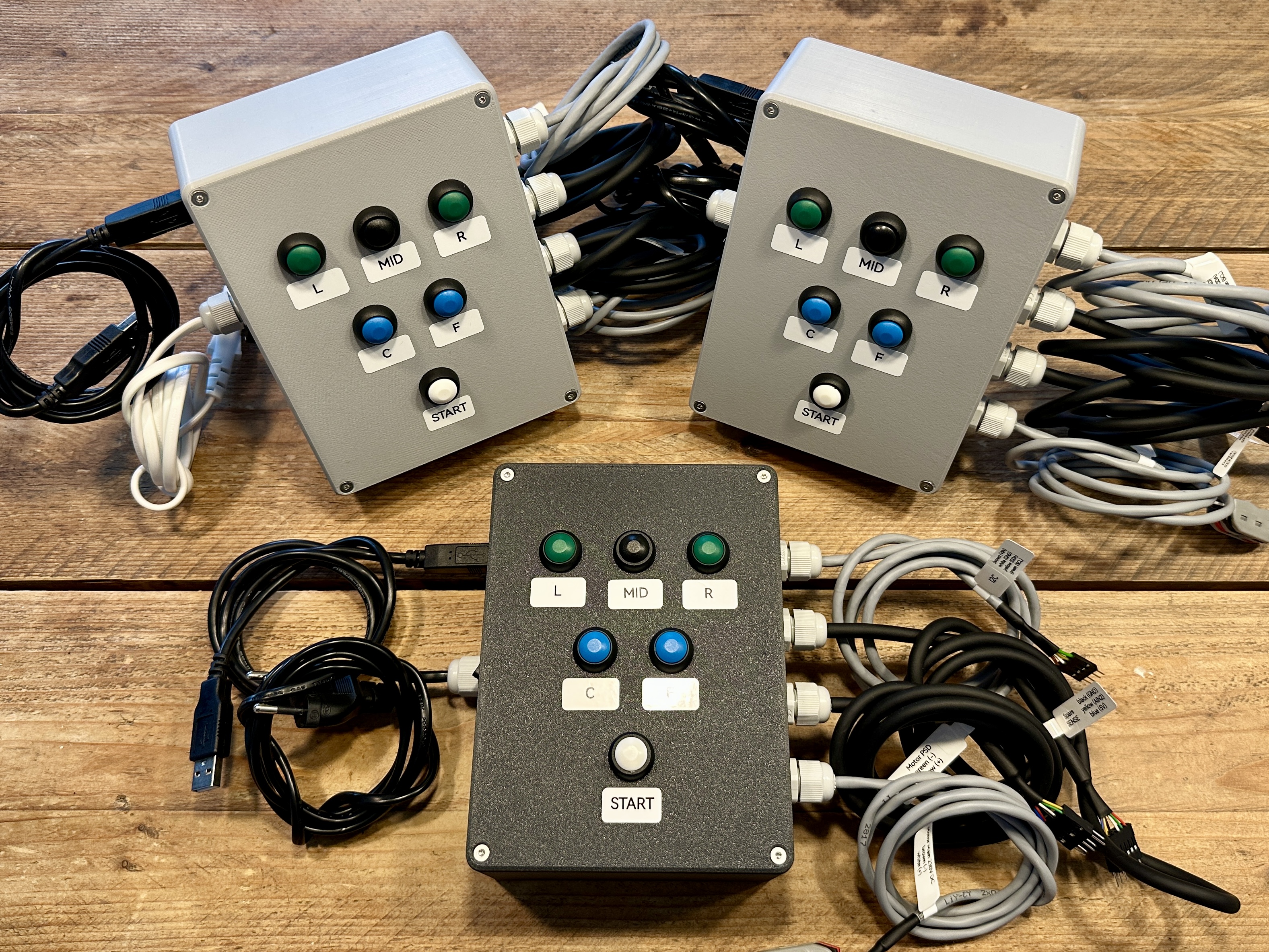
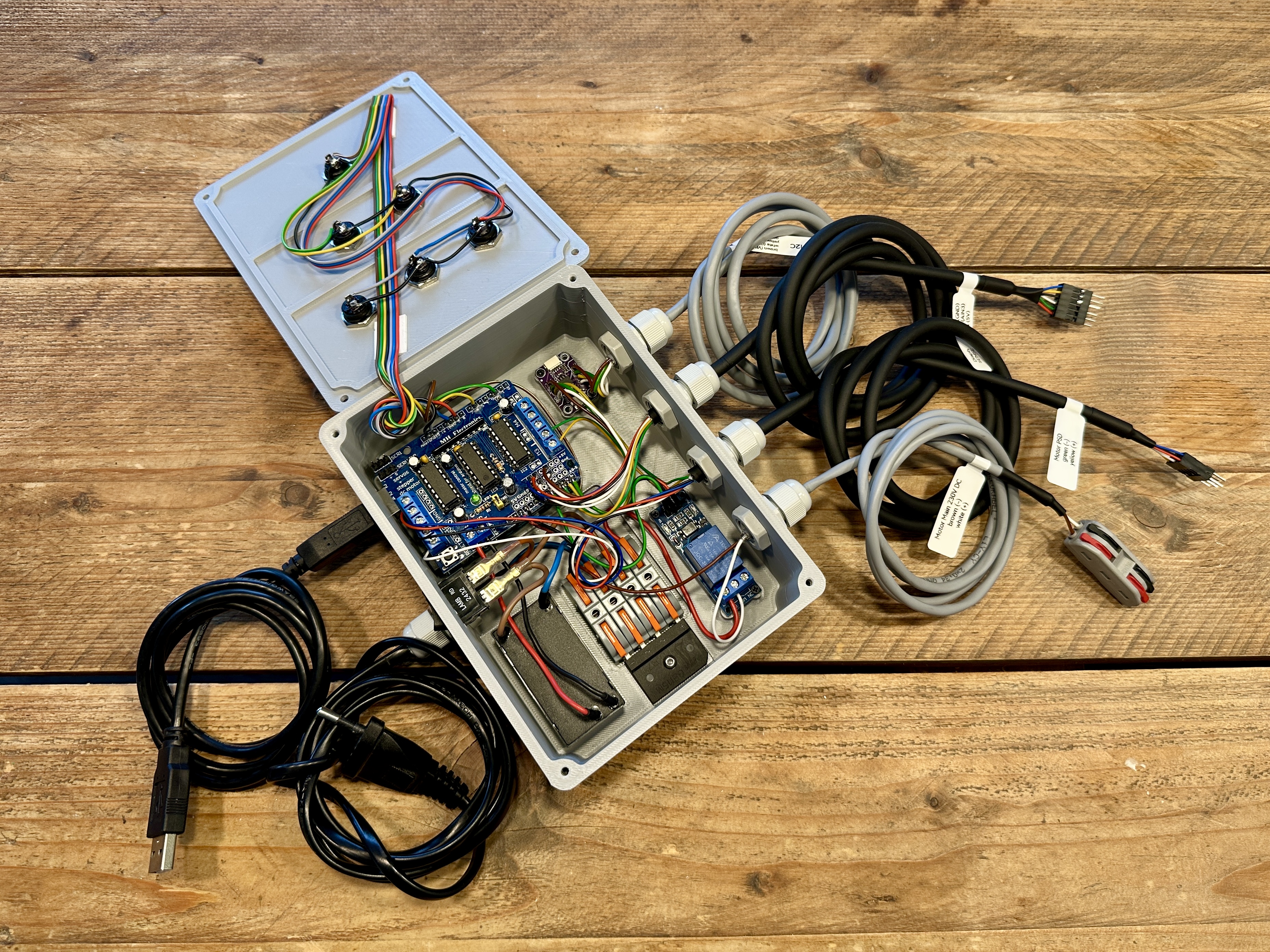
MandE Services & Solutions recently completed a project for Versuni Netherlands B.V (formerly known as Philips Domestic Appliances) and delivered a set of programmable test controllers. MandE developed a programmable device that interacts with consumer product prototypes to realize pre-defined test cycles in a fully-automatic or manual manner. Besides the current project demand, these controllers can be used for many other test cases of mechatronic equipment, thanks to built-in versatility and configurability. Each control box features:
- control of three DC motors in PWM/DIR mode (speed and direction)
- control of one high voltage DC (rectified mains AC) motor in ON/OFF mode
- built-in 24V DC power supply for DC motors
- two digital inputs for ext. 2- or 3-pin sensors (microswitches, Hall sensors, etc.)
- five physical momentary buttons with customisable functions
- USB interface for cycle triggering from PC and controller programming
- I2C interface for interaction with equipment under test and for ext. cycle trigerring
- full optocoupler isolation on I2C for compatibility with 3,3V and 5V systems
Prototype software version (code for built-in Arduino microcontroller) with draft test cycles (manual and automatic) has been vibe-coded with aid of ChatGPT, then tested with desired hardware setup, documented and delivered, with intention for further refactoring by the customer to match their internal standards.


Interesting fact:
I2C protocol was originally developed by Philips Semiconductors in 1980. In the world where I2C “is just there”, with libraries and modules embedded and available everywhere, it was kind of strange to learn about it while developing a project for Versuni, which was also a part of Philips just several years ago. Philips Semiconductors also turned into NXP Semiconductors in 2006. The Philips legacy truly lives on – quietly, but everywhere.
